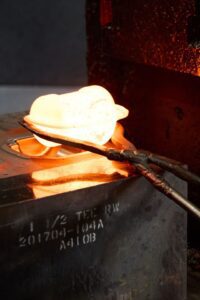
Press forging applies steady, powerful force-rather than a single hammer blow to drive heated metal deep into a customized die cavity. The gradual pressure encourages the workpiece to flow and conform to every contour, producing near-net shapes for critical components such as valves, fittings, and flanges. For industrial procurement managers charged with sourcing high-performance parts, understanding how press forging delivers repeatable accuracy and robust mechanical properties is essential.
Because impression-die press forging (often called closed-die forging) holds the workpiece within a precise cavity, it excels at creating large yet intricate valve bodies, high-pressure fittings, and other safety-critical hardware. The result is a component that pairs efficiency with the kind of consistent quality procurement teams need to keep petrochemical, LNG, and refining facilities running safely and on schedule.
What Is Impression Die Press Forging?
Impression die press forging — often shortened to “impression die forging” or simply “closed-die forging” — is a metal forging process that traps a heated workpiece between two or more dies. The cavities of these dies mirror the desired final geometry. As the forging press applies controlled, sustained pressure, the metal flows to replicate that cavity with remarkable fidelity, yielding near-net-shape valve bodies, flanges, and other high-performance components. Because the dies are precision-machined, every cycle delivers virtually identical results, a critical advantage when you’re responsible for consistent part quality across thousands of pieces.
Unlike open-die hammer work, the closed die fully contains the material on all sides. This setup means less lateral spread, tighter tolerances, and fewer secondary machining steps. This translates directly into lower total cost of ownership for procurement teams. Industry guidance notes that press forging encloses the heated workpiece in a die, allowing plastic deformation to fill even complex cavities with minimal flash and draft, which makes the process popular for safety-critical parts where precision is paramount.
Because impression-die press forging leverages temperature and gradually increasing force, it promotes uniform grain flow, high density, and robust mechanical properties. The result is a metal forging approach that bridges the gap between strength, efficiency, and repeatability.
How Press Forging Works
Press forging begins when bar or billet stock is heated to its optimum hot forging temperature, then transferred to a forging press, either a mechanical press for rapid throughput or a hydraulic forging press for deeper, slower strokes that generate massive tonnage. Once the piece is positioned between the upper and lower dies, the press closes and applies a measured, steadily increasing load that reshapes the metal in one or several controlled strikes.
This method often only requires a few hits to compress the steel and mirror the die impression while confining metal flow for superior precision. The result is a forging process that combines consistency, speed, and the ability to handle durable, corrosion-resistant alloys.
How Impression Die Press Forging Works
Below is a concise walkthrough of the impression-die press forging operation, illustrating why it delivers the uniformity and strength you count on for pressure-containing valves and flanges:
- Heat the workpiece: The steel bar or billet is brought to its forging temperature, ensuring plastic deformation without melting.
- Pre-shape in blocker dies: Edging and blocking impressions guide metal into an approximate form, streamlining the final stroke.
- Apply gradual pressure: A forging press closes the finish dies, forcing the metal to fill every cavity and achieve its near-net shape.
- Trim flash: Removal of the excess material that squeezes out along the parting line, preventing dimensional variation.
- Heat treat and machine: Controlled quenching, tempering, and precise machining bring mechanical properties and tolerances in line with valve specifications.
- Final inspection: We confirm the structural integrity of each forged component and its full traceability through dimensional checks, mechanical testing, non-destructive examination, and documentation. This includes full MTR (Mill Test Report) traceability to ensure compliance with NACE or MIL-spec requirements.
Common Applications of Press Forging
Industrial valves, high-pressure fittings, and ANSI/ASME flanges all benefit from the dense grain structure and repeatability of press forging. Mechanical presses excel at medium-sized components that demand tight tolerances and faster cycle times. Hydraulic presses are used for extremely large or deep-draw parts, such as heavy nozzle necks or specialty petrochemical adapters.
Beyond valve bodies, the same principles support the custom forging of gear blanks, pump housings, and safety-critical aerospace brackets, proving that press forging’s controlled pressure and minimized draft angles translate to savings in both scrap and machining across a variety of steel forging applications.
Impression Die Press Forging vs. Other Methods
Every forging process reshapes metal under force, but how you deliver and contain that force makes a measurable difference in cost, quality, and mechanical performance. Press forging, which fully encloses a heated workpiece within a precision cavity, requires less flash and draft than open-die techniques. This is because the process squeezes the metal rather than allowing it to spread freely. That tighter containment yields cleaner profiles and reduces the post-forging machining burden.
Hammer forging, by contrast, relies on rapid impact from a forging hammer to drive material into specific structural shapes and encourage robust grain flow around webs or ribs. Open-die forging offers flexibility for very large, simple geometries but often trades precision for that versatility, leaving procurement teams to budget extra time and money for machining. Casting can tackle complex shapes at low upfront die costs, but it introduces risks of porosity and inconsistent mechanical properties, which are unacceptable for pressure-retaining valves.
The Advantages and Limitations of Impression Die Press Forging
When you are tasked with securing components that withstand extreme pressures and corrosive media, the foundational benefit of press forging is reliability. By enclosing heated steel in precision dies and compressing it under massive, steady loads, the method produces parts with exceptional internal consistency.
Building on that strength, impression-die press forging offers a series of advantages that translate directly into lower lifetime cost and greater operational confidence:
- Reduced draft angles, which let engineers minimize excess stock and slash downstream machining time.
- Near-net shapes that conserve expensive forging materials and speed overall production cycles.
- Tight dimensional repeatability across large runs, ensuring every forged part meets valve or flange specifications without rework.
- Improved fatigue resistance thanks to continuous grain flow that wraps around bores and fillets.
- Lower scrap rates and better use of energy when compared with more waste-intensive machining or casting routes
Despite these strengths, press forging isn’t without challenges. Chief among them is the upfront investment in precision tooling. However, at US Drop Forge, we mitigate this by in-house die design and manufacturing, which helps us control lead times and costs. It’s also worth noting that the process is most economical at medium- to high-volume production, and the massive presses required can limit part size in some facilities.
FAQs About Press Forging
When Is Press Forging More Cost-Effective Than Other Forging Methods?
Press forging shines when you’re sourcing moderate- to high-volume runs of parts that demand tight tolerances, high strength, or intricate geometries. Because the piece is fully contained during forming, a single operation can trim most of the excess flash, reducing the need for secondary machining.
What Types of Parts Are Best Suited for Press Forging?
Valve bodies, flanges, high-pressure fittings, and other forged components that must endure cyclic loads or corrosive media benefit most from press forging. By driving metal into fully enclosed dies, the process delivers near-net shapes with uniform grain flow-ideal for custom forging of stainless steel or nickel-based alloys. You’ll also find press-forged gear blanks, pump impellers, and structural brackets where consistent strength and tight tolerances are non-negotiable.
Is Press Forging Stronger Than Casting?
Yes. Cast parts solidify from a molten state and can harbor porosity or shrinkage defects. Press-forged parts, on the other hand, are plastically deformed under controlled pressure that refines grain flow and eliminates internal voids. This continuous grain structure boosts fatigue resistance and impact toughness, giving forged parts a clear edge over castings.
Can Press Forging Be Performed Cold, Warm or Hot?
While warm forging can shape certain low-alloy steels, true press forging for high-strength materials almost always takes place at elevated temperatures. Heating the billet into the hot forging range lowers its yield strength, allowing the forging press — or, in the case of massive parts, a hydraulic forging press — to reshape the metal without cracking.
Cold forming exists as a separate process, but for robust alloys such as duplex stainless or Inconel. Hot forging remains the standard for achieving complete plastic deformation and the mechanical properties your specifications require.
Trust US Drop Forge for High-Performance Press Forgings
When schedules are tight and specifications are non-negotiable, you need a partner that executes with speed and accuracy. At US Drop Forge, we combine our modernized tool and die program with rigorous quality standards to deliver mission-critical components that last.
Explore our capabilities and connect with our experts today