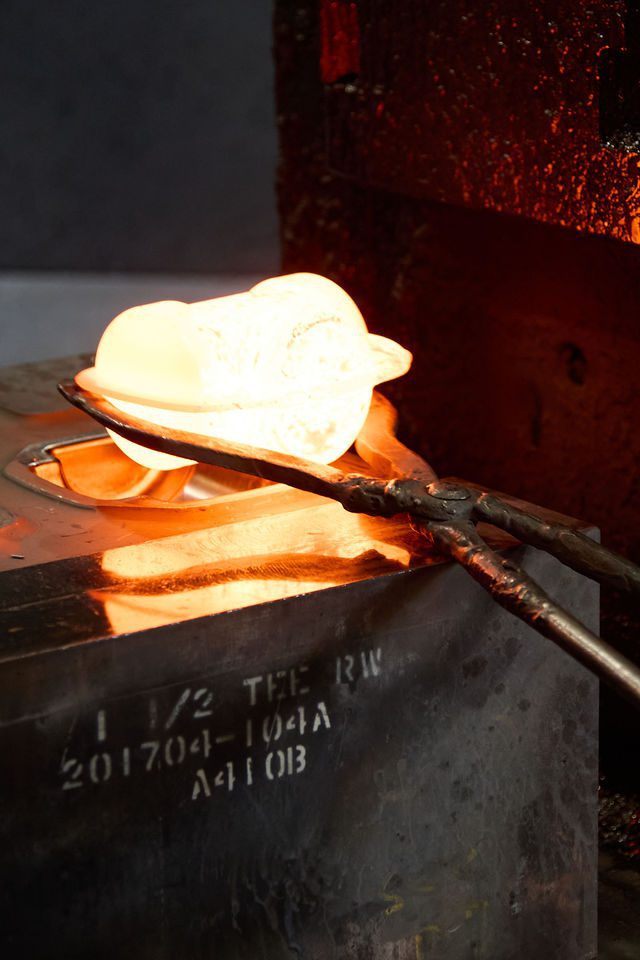
In petrochemical, LNG, and other heavy-industry projects, reliability hinges on components that can shrug off heat, pressure, and corrosion. Closed-die forging is the go-to method for producing those rugged parts because it compresses the metal’s grain flow into shapes that deliver exceptional strength and fatigue resistance. Forging, however, is only the opening act. From heat treatment to electropolishing, a suite of downstream steps ultimately decides whether a part achieves its specified hardness, toughness, dimensional accuracy, and surface integrity.
Recognizing how many links exist between the hammer and the shipping dock, US Drop Forge has built its business around single-source responsibility. By keeping essential secondary operations in-house, US Drop Forge maintains control, certifies every critical parameter, and spares industrial procurement managers the headaches of juggling multiple vendors.
Engineering Material Properties: Heat Treatment
Forging delivers grain flow that is tough to beat, yet the as-forged microstructure is not the finish line. Heat treatment fine-tunes that structure, dialing in hardness, strength, and ductility so each component performs exactly as specified in service. Heat treatment also provides the vital balance between opposing needs. Achieving this harmony ensures parts can withstand both static loads and sudden impacts without cracking.
Beyond mechanical performance, heat treatment offers manufacturers an expansive toolbox. By controlling temperature, atmosphere, and cooling rate, metallurgists can relieve residual stresses and boost wear resistance. For sectors such as nuclear and defense, documentation is as critical as metallurgy. Heat-treat charts trace every soak temperature, dwell time, and quench medium, showing each step met the procedure.
US Drop Forge maintains this chain of custody through rigorous certifications and tracking from furnace door to final inspection. ISO 9001 and PED certificates, coupled with NACE and MIL compliance, verify that every US Drop Forge heat-treated forging is documented and traceable from raw billet to finished part.
Key Processes and Benefits
Manufacturers have a quartet of core heat-treat tools. Each offers unique advantages that can be deployed to match an exact specification.
- Normalizing evens out the microstructure after forging, promoting uniform grain size and preparing the part for subsequent machining or additional thermal cycles. The result is consistent, predictable mechanical behavior in service.
- Quenching and tempering form a well-known one-two punch for high-strength parts. First, rapid quenching locks martensite in place for maximum hardness. Then, controlled tempering eases brittleness and restores toughness.
- Annealing comes next when maximum machinability is the priority. This process of careful heating and slow cooling, a forging relieves internal stresses, softens the metal, and helps prevent distortion during later machining steps, an essential precursor to tight-tolerance work and ductility.
- Stress relieving often serves as the final safeguard. By holding parts below the lower critical temperature, residual stresses left by forging or machining dissipate, reducing the risk of distortion in the field.
With precisely calibrated furnaces and qualified procedures, US Drop Forge delivers repeatable, certified results every time.
Achieving Precision Geometry: Computer Numerical Control (CNC) Machining and Grinding
Forging supplies strength, yet it leaves an intentional “forging envelope” of extra material that has to be removed to hit the tight tolerances found on valve bodies, gear blanks, and other precision components. CNC machining is a reductive process that cuts away this surplus, complementing forging’s shape-forming power with micron-level accuracy.
Because that material allowance is planned, multi-axis machining centers can be programmed to remove it efficiently while producing complex threads, contoured bores, and perfectly flat gasket lands. Holding everything under the same roof also means manufacturers complete parts in a single workflow and eliminate unnecessary freight between suppliers.
When prototype quantities or short runs are necessary, or when interchangeability across large orders must be guaranteed, CNC milling excels by offering high dimensional tolerances and smooth finishes. That precision is equally crucial for subsequent grinding operations, which skim a few thousandths of an inch to erase minor tool marks and establish the final surface finish.
Grinding also removes any shallow forging scale or subsurface inclusions that could undermine coatings or welds later on. By sequencing machining and grinding back-to-back, US Drop Forge ships parts that bolt up cleanly and require no extra prep on the shop floor.
Bundling these operations with forging compresses schedules, tightens quality control, and delivers components that arrive ready for installation.
Functional Finish: Cleaning and Electropolishing
Secondary operations conclude with surface conditioning, where appearance meets performance. By stripping away contaminants and perfecting roughness, manufacturers safeguard corrosion resistance, streamline fluid flow, and simplify downstream assembly.
Cleaning
Every forged part leaves the hammer coated in scale, lubricants, and shop oils. Left untouched, these residues can trap moisture, compromise coatings, and seed corrosion cells. US Drop Forge deploys a sequence of mechanical and chemical methods, including blast cabinets, alkaline washes, and high-pressure rinses, to reveal pristine metal. This clean slate ensures paints, overlays, and non-destructive examination media all bond or penetrate exactly as intended.
Electropolishing (Electro-Finish)
When specifications call for mirror-bright surfaces or ultra-low roughness, electropolishing is often the finishing step of choice. The process immerses a stainless component in an acid electrolyte and applies current to dissolve microscopic high points, leaving behind a chromium-rich, passive layer that boosts corrosion resistance while removing embedded stresses and micro-burrs.
Because US Drop Forge performs this operation, the same inspectors who verified the heat-treat chart also validate surface chemistry and roughness, recording results in the order’s traceability dossier per ISO and PED programs. The outcome is a component that not only looks flawless but also resists pitting, fouling, and bacterial adhesion, attributes that keep pipelines cleaner and maintenance budgets leaner.
Benefit From US Drop Forge’s Essential Secondary Operations
When you source forgings, you are really investing in performance delivered over decades of service. Secondary operations tilt that equation in your favor, converting raw strength into fully qualified parts that arrive on your dock ready to work. At US Drop Forge, we engineer every post-forge process to accomplish three objectives:
- Protect the material’s integrity so it withstands real-world loads and environments.
- Achieve the geometry and surface quality your mating parts demand.
- Document every parameter for seamless compliance reviews.
That rigor pays dividends long after installation. An integrated workflow means fewer hand-offs, faster turnaround, and a single point of accountability. Furthermore, we support every operation with a certification package that satisfies ISO 9001, PED, NACE, and multiple nuclear and military standards. And we track each order from billet to barcode, a level of traceability maintained through a proprietary database and rigorous quality audits. The result: forged components that move seamlessly from receiving inspection to the assembly line, eliminating the cost and risk of additional processing.
Don’t let logistics stretch your lead time. Contact US Drop Forge for a quick quote on turnkey, ready-to-install components today.