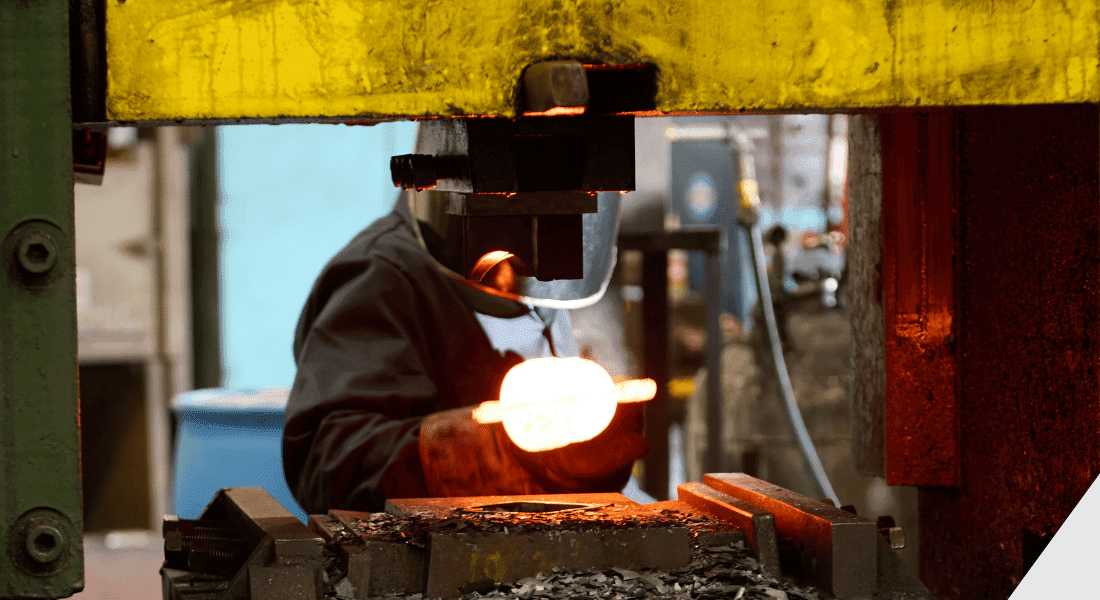
Forging is one of the oldest, most dependable manufacturing techniques, and it’s still indispensable across modern industries. By reshaping heated metal with compressive force, a well-designed forging process produces valve bodies, fittings, brackets, and other metal components that outperform cast or fabricated alternatives. Petrochemical, power generation, and naval organizations prefer this forged metal, and selecting the right forging process can mean the difference between reliable operations and an unexpected shutdown.
From closed-die forging to seamless rolled-ring forging, understanding the different types of metal forging helps ensure every part arrives with the mechanical properties, dimensional accuracy, and traceability required by critical applications.
The Different Types of Forging Processes
Choosing the optimal metal forging method depends on part geometry, alloy family, mechanical property targets, and production volume. Four core processes address most industrial needs, with closed-die forging leading the way for precision flow-control components and other high-performance metal parts.
Impression-Die / Closed-Die Forging
In closed-die forging, often referred to as drop forging, a heated billet fills a pair of precision-machined dies that mirror the part’s final geometry. As a primary method of hot forging, the dies close, and metal flows under extreme compressive force, eliminating voids and consolidating grain structure for exceptional strength and reliability.
This method yields near-net shapes and enhanced durability, which makes it indispensable for mission-critical applications.
Press forging applies a continuous, controlled squeeze, rather than an impact, distributing force uniformly throughout the alloy. This is the ideal method for intricate geometries and tight tolerances. Presses apply steady pressure, extend die life, and scale efficiently for high-volume parts produced on mechanical forging operations.
Drop hammers, by contrast, deliver a series of high-energy strikes that refine grain flow, an advantage for components such as yokes or brackets that endure cyclical loads.
Open-Die Forging
Open-die forging shapes hot metal between flat or contoured dies without fully enclosing the workpiece. This hot forging technique shapes the forged metal into the desired shape, prioritizing directional strength and bulk deformation over fine detail. Because the dies do not capture the entire geometry, machining is typically required after forging, yet the method is practical for marine propeller shafts, mining equipment hubs, and other oversize parts where scale outweighs tight tolerance needs.
Cold Forging
Cold forging deforms forged steel, copper, or aluminum at cooler temperatures. By forcing the material into the desired shape, eliminating reheating saves energy, improves surface finish, and achieves repeatable dimensions within thousandths of an inch. Work-hardened grain structure raises yield strength and hardness, making the technique attractive for fasteners, pins, and small forged parts that must resist wear without additional heat treatment. Higher forming loads limit material selection and demand robust forging equipment capable of sustaining elevated forces during each stroke.
Seamless Rolled-Ring Forging
Seamless rolled-ring forging, known as a specialized roll forging method, starts with an open-die preform that is pierced and expanded over a mandrel, then rolled radially and axially until the ring reaches its specified diameter and wall thickness. Grain flows circumferentially, delivering outstanding hoop strength for bearings, gear blanks, and flanges. When flow-control components require ribs, bosses, or complex sealing surfaces, closed-die forging remains the preferred method to capture those features without excessive machining.
Key Differences Between Forging Methods
The four processes apply force differently, establish distinct thermal profiles, and direct grain flow in unique ways, all of which dictate forged component performance.
Closed-die forging confines metal within precision cavities, aligning grain with load paths and eliminating internal voids. This enclosure promotes high density and tight tolerances in drop forging, making this manufacturing process ideal for valve bodies and high-pressure fittings that endure cyclic pressure and vibration.
Open-die forging uses repeated compression between flat dies. The workpiece elongates and work-hardens, but since the dies do not encapsulate the full geometry, tolerances are broader and machining allowances are larger. This trade-off is acceptable when bulk strength for oversized parts takes precedence over net-shape accuracy.
Cold forging enhances hardness and strength. Excellent material utilization and surface finish make it cost-effective for high-volume production of any forged component, provided the alloy retains sufficient ductility to avoid cracking.
Rolled-ring forging orients grain around the ring circumference, strengthening the part against torsion and thermal cycling. While roll forging helps shape the ring, it lacks the capability to create complex three-dimensional features without further machining.
From an equipment standpoint, hammer forging offers rapid impact energy that promotes fine grain but can introduce greater dimensional variability. Press forging’s controlled squeeze supports uniform deformation, extended die life, and compatibility with automated handling systems, reducing variation throughout the forging operations in high-volume environments.
How To Choose the Right Forging Process
Selecting the right forging process requires engineers and procurement managers to weigh five key factors: service environment, material, geometry, volume, and compliance.
- Service environment: Components exposed to high temperatures, corrosive media, or intense vibration often benefit from the void-free, aligned grain structure of closed-die forgings. For critical petrochemical and naval applications, choosing a certified closed-die provider prevents catastrophic field failures. Cold climates that demand high toughness may favor high-performance drop forging, while enormous shafts for hydroelectric plants usually rely on open-die forging.
- Material: Carbon steels up to 100 lbs, alloy steels to 75 lbs, stainless steels to 50 lbs, and high-temperature alloys to 25 lbs, all produced under ISO 9001 and Pressure Equipment Directive (PED) certifications.
- Geometry: Complex cavities, specialized valve bodies, and tight-tolerance surfaces point toward closed-die press or hammer forgings. Simpler massive shapes like long shafts or rings are better suited for open die or roll forging.
- Volume and cost: Press forging, with its single-stroke action and compatibility with mechanical presses, scales efficiently and reduces unit cost in large orders. Hammer operations often suit low-to-medium volumes where superior grain refinement justifies the investment.
- Schedule and documentation: A precision-forging supplier’s homepage notes that buyers can secure quick, efficient quotes for custom forging and fully traceable orders in roughly 12 weeks, advantages that help projects stay on schedule.
In mission-critical applications, a forging is only as reliable as its documentation. US Drop Forge ensures 100% material traceability by inventorying original mill test reported materials across UNS category grades (including ASTM, ASME, ISO, SAE, MIL, TUV, and IBR).
Our facility maintains rigorous quality control frameworks approved by major global governing bodies:
- ISO 9001:2015 Standard Certified
- Pressure Equipment Directive (PED) 2014/68/EU, Annex I, Section 4.3
- Full compliance with NACE, NCA, NQA, CSA, MIL, NRC, and DFARS requirements.
Through our integrated tracking systems, Material Test Report (MTR) data, non-destructive examination (NDE) records, and dimensional verifications remain fully traceable and accessible throughout the component’s entire lifecycle.
By balancing these factors, engineers and procurement managers can match each application to the forging method that delivers maximum reliability at the lowest total lifecycle cost.
FAQs About Forging
Here are some frequently asked questions about the different types of forging:
What Are the 4 Types of Forging?
Closed-die, open-die, cold, and seamless rolled-ring forging represent the four primary industrial methods, each differing in die design, temperature range, and precision.
What Are the Benefits of Closed-Die Forging?
When metal is fully enclosed by precision tooling, grain aligns with load paths, internal voids are eliminated, and near-net shapes minimize machining, resulting in stronger, more fatigue-resistant components.
Which Metal Cannot Be Forged?
Extremely brittle metals with very low ductility, such as high-carbon white cast iron or certain hard intermetallic compounds, fracture instead of plastically deforming under forging pressure and are therefore unsuitable for forging.
How Many Forging Techniques Are There?
Dozens of specialized variations and different types exist, including upset forging to increase diameter, warm forging, isothermal forging, roll forging, and orbital forging, each tailored to particular geometries or material behaviors.
How Do Different Forging Types Affect Material Properties?
Temperature (as seen in hot forging), strain rate, and die confinement shape grain size, orientation, and density. Impression-die methods refine and align grain, boosting tensile and fatigue strength. Cold forging increases hardness, while rolled-ring forging enhances hoop strength. Open-die forging delivers coarse but directionally strengthened grains for heavy-duty parts.
Which Forging Process Produces the Least Material Waste?
Closed-die and cold forging typically achieve the highest material utilization because they produce near-net shapes that require minimal machining or flash removal. Open-die and rolled-ring methods remove more material during finishing, but they remain efficient for very large or ring-shaped parts.
Can the Same Part Be Made Using Different Forging Methods?
A simple flange could be produced by several methods, yet each route affects grain flow, tolerance capability, cost, and lead time. For a complex forged part, closed-die forging is usually the only economical way to achieve the necessary precision and performance.
What Type of Forging Do You Need?
Every project balances performance targets, budget constraints, and delivery timelines. Clarifying those priorities helps pinpoint the manufacturing process that best suits your needs. At US Drop Forge, we’re committed to high-quality custom forging. To review our full range of precision forging services, materials, and testing capabilities, explore our capabilities or contact us to discuss specific custom forging requirements.