How Impression Forging Reduces Machining and Guarantees Grain Flow in Complex Geometries
Introduction: The Forging Advantage in Precision Manufacturing
When mechanical reliability is non-negotiable, and every strand of metal matters, impression forging stands out as the process of choice. Unlike machining from billet or casting, impression forging (also called closed-die forging) shapes hot metal under extreme compressive force inside precision dies, resulting in near-net shape components that possess controllable directional grain flow, elevated toughness, and outstanding fatigue resilience.
Industries from aerospace and defense to energy, transportation, and heavy machinery rely on this process to produce task-critical parts such as valve bodies, turbine discs, connecting rods, and high-pressure fittings and flanges. For US Drop Forge, mastering impression forging means combining metallurgical precision with design innovation, producing parts that go from concept to high stress task with minimal machining and near-zero rejection rates.
The Mechanics of Impression Forging
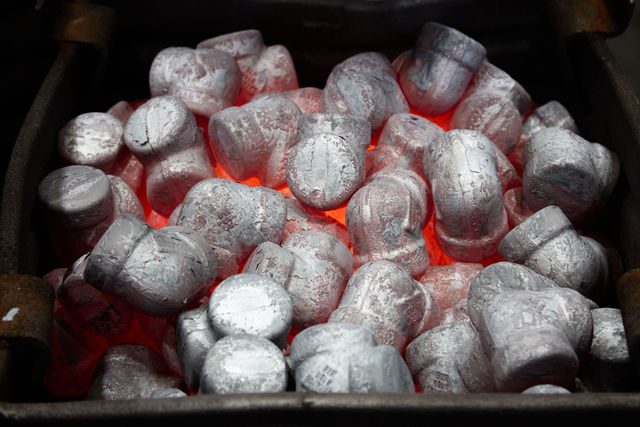
In impression forging, a heated billet is placed between upper and lower dies that encompass the impression of the finished-part geometry. As force is applied, the material flows to fill the cavity completely, aligning crystalline structure and grain boundaries as an internal grain flow, following the contours of the final shape.
This process differs from open-die forging, which simply compresses and elongates metal between flat dies, or casting, where molten metal solidifies in a negative cavity with very limited control of grain morphology.
The impression forging process ensures:
- Controlled deformation and high density (eliminating internal voids)
- Directional grain flow following load-paths
- Enhanced tensile and fatigue strength
- Tighter dimensional tolerances than other net-shape processes before machining
| Process | Strength & Toughness | Dimensional Accuracy | Grain Flow Control | Material Waste | Typical Applications |
| Casting | Low–Medium | Medium | None | Low | Complex shapes, low stress parts |
| Machining from billet | Medium | High | None | High | Precision components |
| Open-die forging | High | Medium | Partial | Medium | Shafts, rings |
| Impression forging | Very High | High | Excellent | Low | Valves, gears, flanges, aerospace parts |
Table 1: Comparison of Common Metal Forming Processes
Near-Net Shape Forging: Reducing Machining, Maximizing Efficiency
A key advantage of impression forging is its ability to produce near-net shape parts – meaning that the forged component closely resembles the final geometry, requiring only light finishing operations.
Benefits of Near-Net Shape Forging:
- Reduced machining time – typically 50–80% less than billet machining
- Lower material waste, especially in high-value alloys like Inconel, titanium, and stainless steel
- Improved repeatability across large runs
- Enhanced surface quality for sealing and mating faces
For complex parts such as flanged adapters, valve bodies, and aerospace clevises, the near-net approach means designers can combine geometric precision with the strength advantages of forging.
In industries like oil and gas or nuclear power, this level of precision matters. Machining large volumes from solid billet is costly – not just in time, but also in wasted material. Near-net forging aligns with lean manufacturing and sustainability objectives, minimizing scrap while maximizing the yield per billet.
Grain Flow: The Hidden Strength in Forging
The performance advantage of forged components lies deep within the metal’s internal structure. During impression forging, as the material fills the die cavity, its grains are elongated and reoriented to follow the part’s geometry and stress paths.
This grain flow continuity is critical in:
- Pressure-retaining parts (e.g., flanges, fittings, valve housings)
- Rotating components (e.g., crankshafts, turbine discs)
- Load-bearing structures (e.g., suspension brackets, tie rods)
When properly designed, grain flow acts like reinforcing fibers in composite materials – distributing stresses more evenly and preventing premature crack initiation.
Forged parts exhibit grain structures that “wrap” around features such as holes, fillets, and bosses, enhancing fatigue life. In contrast, machined parts from rolled stock cut through the grain flow, creating stress risers and weak points under cyclic loading.
From CAD to Die: The Role of Engineering Simulation
Modern impression forging leverages 3D CAD modeling, finite element analysis (FEA), and thermal simulation to predict material flow and optimize die design.
US Drop Forge’s engineering process integrates:
- Material flow simulation to prevent underfill, laps, or cold shuts
- Die stress analysis for longer die life
- Cooling and temperature control optimization
- Flash management to reduce post-forging trimming
By simulating how metal fills each die cavity, engineers ensure consistent microstructure, minimal porosity, and predictable mechanical performance.
| Parameter | Purpose | Benefit |
| Flow stress model | Predicts deformation behavior | Reduces defects |
| Thermal profile mapping | Manages temperature gradients | Enhances uniformity |
| Flash allowance modeling | Optimizes material distribution | Minimizes waste |
| Die wear simulation | Extends tooling lifespan | Reduces downtime |
Table 2: Simulation Parameters in Impression Forging Process Design
Material Versatility: Forging High-Performance Alloys
Impression forging is compatible with a broad range of alloys – from Carbon and alloy steels to superalloys, Magnesium, and Titanium – each requiring precise temperature control and die design.
Common materials for impression forging:
- Carbon and alloy steels: 1045, 4140, 4340 – ideal for strength and durability
- Stainless steels: 304, 316, 410, 17-4PH – corrosion-resistant and weldable
- Nickel and Cobalt alloys: Inconel 718, Monel 400 – used in high-temperature or corrosive environments
- Titanium alloys: Ti-6Al-4V – aerospace-grade strength-to-weight performance
For each material, US Drop Forge applies specific forging temperatures, controlled deformation rates, and post-forging heat treatments to ensure dimensional stability and mechanical consistency.
Applications: Real-World Performance of Impression-Forged Components
Impression-forged components are indispensable wherever performance cannot be compromised.
Industries benefiting from impression forging:
- Oil & Gas: High-pressure flanges, valve bodies, and flow control fittings
- Aerospace: Landing gear components, engine mounts, and linkage arms
- Defense: Weapon system housings, armored vehicle joints
- Energy: Turbine rings, pump housings, generator shafts
- Transportation: Axle yokes, suspension components
In these applications, zero-failure tolerance is the basic expectation. The mechanical reliability and consistent grain structure of forged parts ensure they can withstand shock, vibration, and pressure extremes that would cause cast or machined parts to fail.
The Zero-Failure Mindset: Quality Assurance and Testing
To achieve zero failures in service, every step of the forging process is controlled, validated, and tested.
US Drop Forge’s quality assurance framework includes:
- Non-destructive testing (NDT): ultrasonic, magnetic particle, and dye penetrant inspection
- Mechanical testing: tensile, impact, hardness, and grain flow verification
- Dimensional validation: coordinate measuring machine (CMM) inspection
- Metallurgical examination: microstructure and grain flow alignment
All forgings are traceable to material heat lots and process documentation, meeting or exceeding ASTM, ASME, and API standards for industrial and energy-grade components.
The Sustainability Edge
Because impression forging minimizes waste and extends component service life, it also supports sustainability goals across manufacturing ecosystems.
Compared to machining or casting, the process consumes:
- Up to 30% less raw material
- Lower energy input per component
- Reduced scrap recycling needs
By combining efficient material flow with near-net accuracy, impression forging contributes to environmental efficiency without compromising mechanical integrity.
Key Takeaways
Forged components outperform machined and cast alternatives in strength, durability, and sustainability.
Impression forging delivers near-net shapes, minimizing machining and material waste.
Controlled grain flow enhances strength, fatigue resistance, and part longevity.
Simulation-driven design ensures precision, consistency, and defect-free production.
Quality control underpins the zero-failure objective in demanding applications.
In Closing
We hope you enjoyed this article. If you would like to learn more about our capabilities or request a quote, please contact us today to get started.